


The fundamental rules and structures of Arabic grammar provide you with an understanding of how the language functions. Here is a basic explanation for newcomers:
Arabic Alphabets:
The following are some vital details with respect to Arabic alphabets:
It is written from right to left.
Depending on where they are in the word—beginning, middle, end, or isolated—letters change shape.
Instead of being written with letters, short vowels are added with diacritical marks.

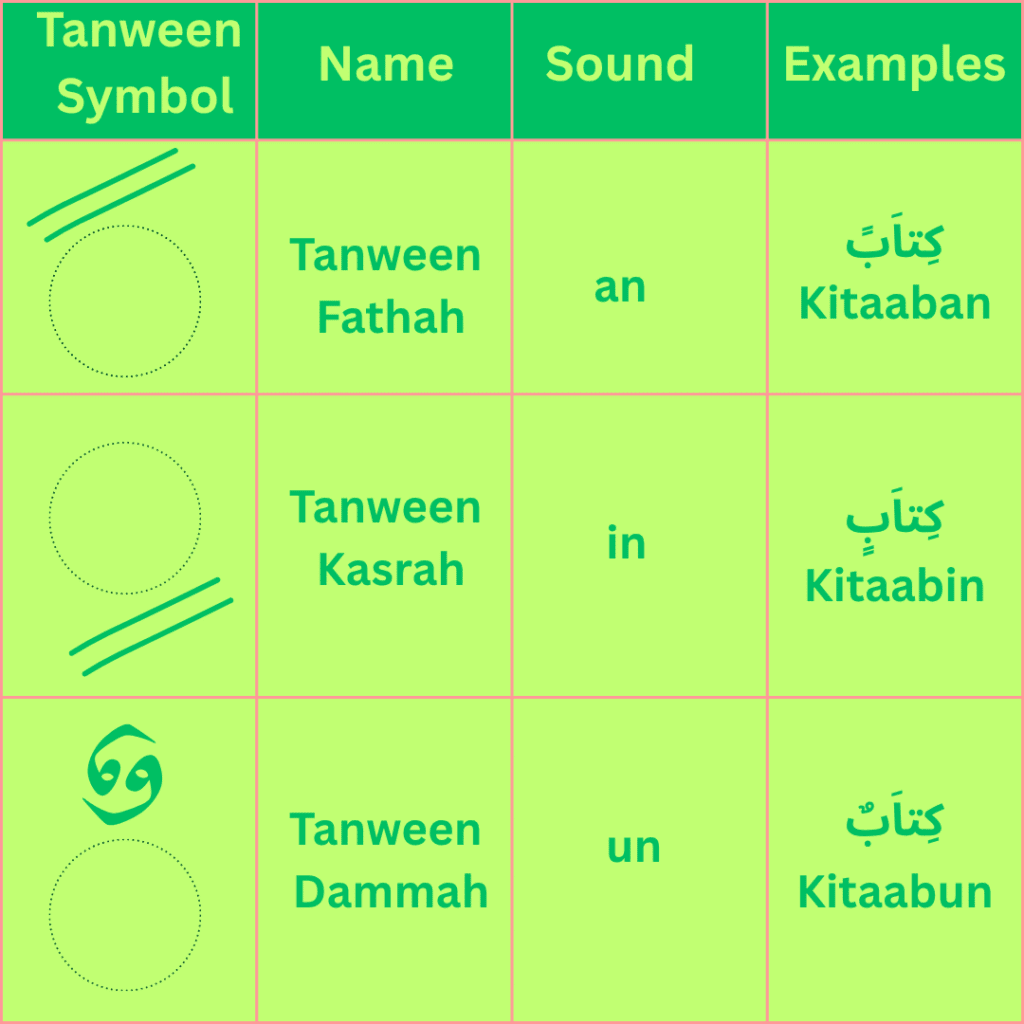
2. Tanween التنوين:
What is it?
Tanween is the term for the double short vowel marks (Harakah) that are used to indicate that a noun is:
Indefinite (similar to the English words “a” or “an”)
as well as its grammatical case (after preposition, subject, or object).
Tanween ends the word by making the “n” sound.
3. The Three Main Parts of Speech:
Arabic language revolves around 3 Main Categories:
- اسم (Ism) – Noun
- فعل (Fiʿl) – Verb
- حرف (Ḥarf) – Particle / Preposition / Conjunction
We have already explained in short about these in my other Blog Post.
4. Sentence Structure:
There are 2 main types of sentences-
- الجملة الاسمية (Al-Jumla Al-Ismiyyah) – Nominal Sentence
This type of sentence starts with a noun (اسم)
Example: اَلْوَلَدُ صاَلِحٌ– The boy is Righteous. - الجملة الفعلية (Al-Jumla Al-Fiʿliyya) – Verbal Sentence
This type of sentence starts with a verb (فعل)
Example:ذَهَبَ زَيْدُ – Zaid went. - مُبْتَداْ (Subject) and خَبَرْ (Predicate) Example: اَلرَّجُلُ صاَدِقٌ– The man is honest.
5. Basic Tenses in Arabic:
- فعل ماَضِي– Past Tense; Example- نَصَرَ – He Helped
- فعل مُضاَرِع- Present and Future Tense (depending upon the sentences); Example- يَنْصُرُ – Present: He helps; Future: He will help.
6. Tips to Master Arabic grammar:
- Practice Harakaats
- Build up your Vocabulary using Flashcards from different apps like Quizlet, Memrise etc.
- Use beginner friendly grammar books.
Summary:
The set of rules of its grammar allows the formation of proper and significant sentences. Nouns (اسم), verbs (فعل), and particles (حرف) are its three primary building blocks. Arabic sentences can be either verbal- الجملة الفعلية (Al-Jumla Al-Fiʿliyya)– beginning with a verb or nominal- الجملة الاسمية (Al-Jumla Al-Ismiyyah)– beginning with a noun. Every noun can be masculine or feminine, singular, dual, or plural, definite or indefinite.
it also illustrates the grammatical function of words in a sentence by using case endings (iʿrāb). Tanween, the double vowel marksthat denote case and indefiniteness, is a unique characteristic.
Subjects and verbs must agree because verbs are conjugated according to tense, person, gender, and number. Gaining confidence in speaking, writing, and reading is facilitated by knowing these fundamentals, which also make learning Arabic grammar much simpler.
In my upcoming posts, we will delve deeper into these subjects.


[…] Basics of Arabic Grammar: […]